1Which study are you planning?
What each requirement means
- Every gage in the control plan gets a studyIATF
If a measurement is in your control plan, your customer expects proof the gage can be trusted. The methods and acceptance criteria come from the AIAG MSA manual unless the customer agrees to others.
IATF 16949:2016, clause 7.1.5.1.1 - 10 parts × 3 operators × 3 trialsAIAG
The MSA manual's worked example, and the design most customers expect. Repeat readings show how much one person disagrees with themselves (repeatability); several operators show how much people disagree with each other (reproducibility).
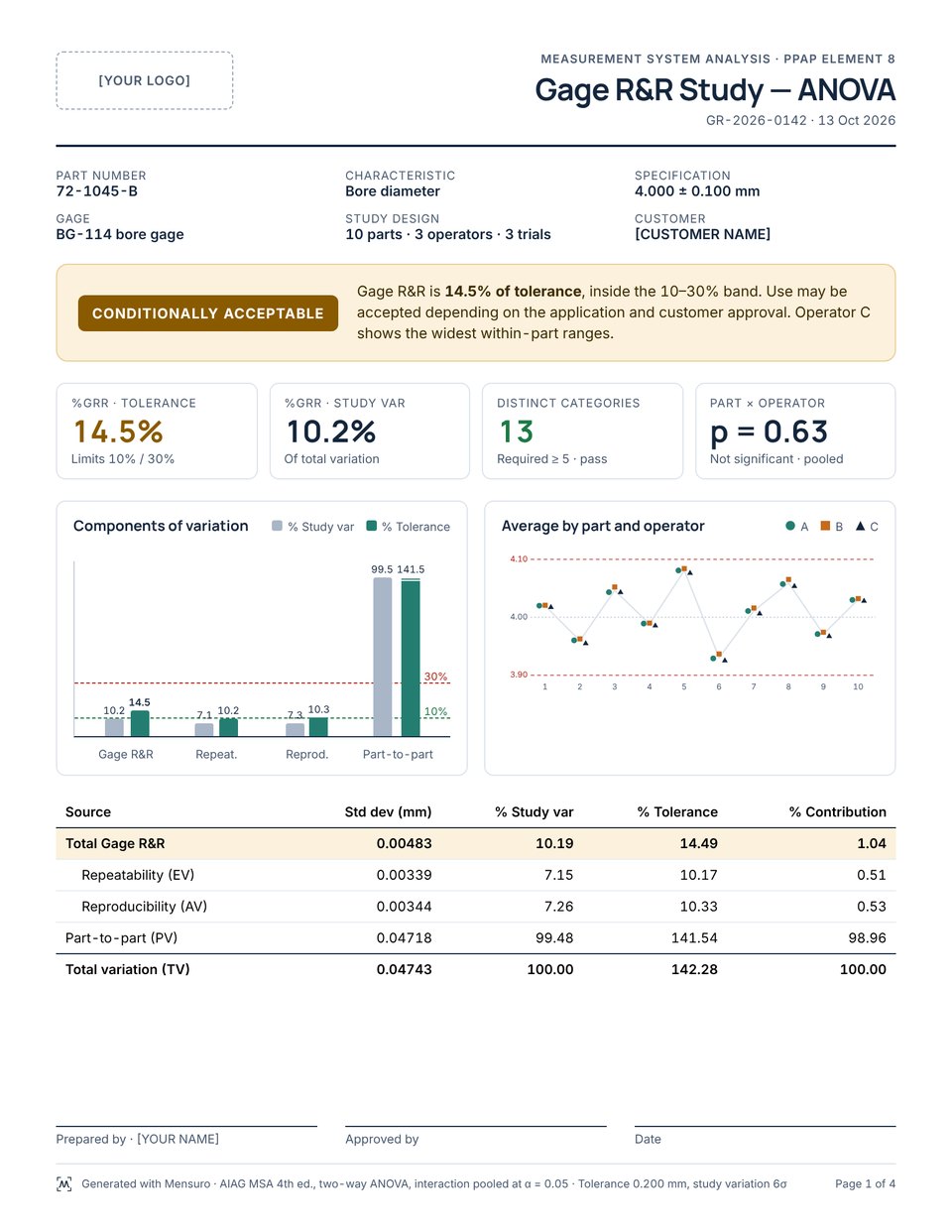
AIAG MSA, 4th edition - %GRR under 10% passes, over 30% failsAIAG
%GRR is the share of the variation you see that's really the gage. Under 10%, the gage is barely noticeable. 10% to 30% may be acceptable, depending on the application and cost. Over 30%, the gage is a big part of what you're measuring.
AIAG MSA, 4th edition - ndc of 5 or moreAIAG
The number of distinct categories: how many groups of parts the gage can reliably tell apart across your process. Below 5, it can't sort parts finely enough to control the process.
AIAG MSA, 4th edition - Resolution of one-tenth or finerAIAG
The gage's smallest step should be no more than a tenth of the process variation or tolerance. Coarser, and readings bunch into a few values that hide real differences.
AIAG MSA, 4th edition - Pick parts across the whole rangePractice
Measure a batch first and choose parts spread across it. Ten parts bunched in the middle make ndc and %study variation look worse than the gage really is.
Common practice - German OEMs may ask for uncertainty insteadISO / VDA
VDA Volume 5 and ISO 22514-7 judge measurement processes by measurement uncertainty (QMS, QMP) rather than %GRR. If your customer works to VDA 5, ask which studies they want.
VDA Volume 5, 3rd edition (2021); ISO 22514-7:2021
Customer example: Ford Specifics for PPAP, Jan 2025
One OEM's published minimums, for comparison. Other customers set their own; check yours.
- At a minimum 10 parts, 3 operators, 3 trials, using the ANOVA method. Parts must represent a production run with all known sources of variation and use the full range of part-to-part variation. §2.2.8
- Report %GRR as both % of study variation and % of tolerance. Under 10% of tolerance acceptable; 10% to 30% needs the site STA engineer; over 30% unacceptable. Hold parts in production-intent fixtures. §2.2.8
What each requirement means
- 50 parts × 3 appraisers × 3 trialsAIAG
The MSA manual's attribute example. Enough judgements to tell whether appraisers agree with each other, with themselves and with the right answer.
AIAG MSA, 4th edition - Kappa above 0.75AIAG
Kappa measures how often appraisers agree beyond what luck alone would give. Above 0.75 is good agreement; below 0.40, the inspection is close to guessing.
AIAG MSA, 4th edition - 90% effective, ≤ 2% misses, ≤ 5% false alarmsAIAG
For each appraiser: the share of parts judged correctly, how often a bad part is passed (a miss, which reaches your customer) and how often a good part is rejected (a false alarm, which costs you scrap).
AIAG MSA, 4th edition - Borderline parts on both sides of each limitPractice
Easy parts tell you nothing. Include parts just inside and just outside each limit, plus some clearly good and a few clearly bad, and measure each with a variable gage first so it has a known right answer.
Common practice - Blind and shuffledPractice
Code the parts so appraisers can't recognise them, and change the order every trial. Otherwise people remember their earlier answers and agreement looks better than it is.
Common practice
- 8 parts × 20 checks per limitAIAG
At least 8 parts with known values at roughly equal steps around the limit. The part furthest outside should be accepted 0 times out of 20, the one furthest inside 20 times, and the parts between 1 to 19 times. That pattern shows how sharply the gage switches from pass to fail.
AIAG MSA 4th edition, analytic method, as summarised by Minitab - Each limit is studied on its ownAIAG
The method estimates the gage's bias and repeatability at one limit. A two-sided tolerance needs a set of parts around each limit.
AIAG MSA, 4th edition - Fewer bad parts, not nonePractice
You still need a part or two just beyond the limit, but no gross rejects. If the feature can be measured with a variable gage at all, a variable Gage R&R needs no bad parts and tells you more.
Common practice - Ask your customer firstPractice
Some customers name the 50 × 3 × 3 agreement study as their minimum and won't accept the analytic method in its place.
Common practice
Customer example: Ford Specifics for PPAP, Jan 2025
One OEM's published minimums, for comparison. Other customers set their own; check yours.
- At a minimum 50 parts, 3 operators, 3 trials. Part mix: 25% near the lower limit and 25% near the upper limit (on both sides of each), 30% across the expected process variation, and 10% outside each gauge limit. Measure every part independently with a variable gage first. §2.2.8
- All kappa values (between appraisers, within each appraiser, and each appraiser against the standard) should be greater than 0.75, and the gauge must reject every part outside the specification. §2.2.8
What each requirement means
- 50 readings, at least 25Bosch
Repeated readings of one reference part, by one operator, in a short time. Fifty gives a steady estimate of the gage's scatter; fewer than 25 is too few to judge.
Bosch Booklet No. 10, Procedure 1 - Cg and Cgk of 1.33 or moreBosch
Cg compares the gage's scatter with 20% of the tolerance. Cgk also counts how far the gage's average sits from the reference value (its bias). At 1.33 or more, the gage's own error uses only a small slice of the tolerance.
Bosch Booklet No. 10: Cg = 0.2T / 6s, Cgk = (0.1T − |bias|) / 3s - Resolution of 5% of the tolerance or finerBosch
A gage that reads in big steps can't show small changes. With a 0.06 mm tolerance, that means steps of 0.003 mm or finer.
Bosch Booklet No. 10 - A reference part near the middlePractice
Choose a part close to the middle of the tolerance and use its calibration certificate value as the reference. Load and unload it between readings, just as in normal use.
Common practice - ISO and VDA start the same wayISO / VDA
VDA Volume 5 and ISO 22514-7 also begin with repeated readings of a reference standard, but judge them through measurement uncertainty rather than Cg and Cgk.
VDA Volume 5, 3rd edition (2021); ISO 22514-7:2021
What each requirement means
- At launch: above 1.67 passes, below 1.33 failsAIAG
For an initial process study, an index above 1.67 is acceptable; 1.33 to 1.67 may be acceptable with your customer's approval; below 1.33 isn't. 1.67 means your average sits 5 standard deviations inside the nearer limit, 1.33 means 4.
AIAG PPAP, 4th edition, initial process study - In ongoing production: 1.33 is the usual targetPractice
A short launch study usually looks better than months of production, with its tool wear, material lots and shift changes. Asking 1.67 up front leaves room for that, so the process still holds 1.33 later. Many customers write 1.33 into their requirements for ongoing production.
Common in customer-specific requirements - Stable first, capable secondAIAG
Capability predicts future parts only if the process is in statistical control. A control chart of the same data comes first; an unstable process needs fixing, not a capability index.
AIAG PPAP, 4th edition - 25 subgroups of 5Practice
Groups of consecutive parts, spread through the run. The scatter inside each group gives the short-term spread (Cp, Cpk); the differences between groups show drift (Pp, Ppk). Control chart texts base limits on 20 to 25 subgroups.
D. C. Montgomery, Introduction to SQC, 6th edition - Each cavity judged on its ownPractice
A multi-cavity tool is several processes sharing one press. One cavity running off-center can hide inside a combined number that looks fine, so plan enough readings per cavity and record the cavity with every reading.
Common practice - Cp, Cpk, Pp and Ppk are defined in ISO 22514-2ISO / VDA
The international standard behind the indices and the process models they assume. Your customer may name it alongside, or instead of, the AIAG manuals.
ISO 22514-2
Customer example: Ford Specifics for PPAP, Jan 2025
One OEM's published minimums, for comparison. Other customers set their own; check yours.
- At least 25 subgroups of at least 5 consecutive parts, for a minimum of 125 measurements from a run of at least 300 parts, spaced evenly through it. Complete the MSA first. §2.2.11.1
- The data must include the full range of expected variation: all tools, all cavities, all streams, all shifts. Parts are measured from every cavity. Ppk of 1.67 or more, from a statistically stable data set. §2.2.9, §2.2.11.1
Already have the readings? Check them in the free Cpk calculator →
What each requirement means
- Reuse is the customer's callIATF
Measurement systems are studied as they're used in the control plan. Whether a study carries over to another part is up to your customer, so give the reviewer the evidence rather than a bare claim.
IATF 16949:2016, clause 7.1.5.1.1 - Recheck the verdict at the new tolerancePractice
Only %GRR of tolerance changes. Halve the tolerance and the same gage error takes up twice as much of it, so a gage that passed at 8% can sit at 16% on the new part.
Common practice - Study variation and ndc may not carry overPractice
%GRR of study variation and ndc describe the parts in the original study. They only hold for the new part if its process varies about as much.
Common practice